
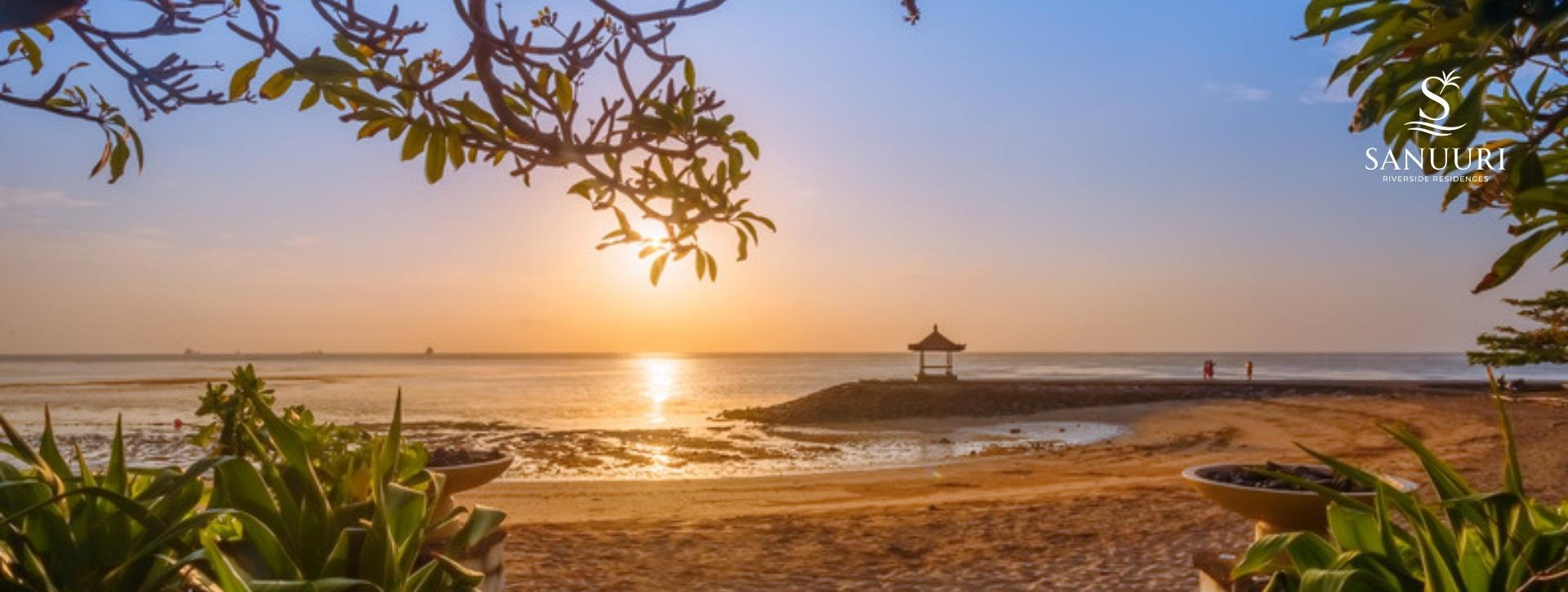
Bali sits about eight degrees south of the equator, so temperatures hold at roughly 27 to 31°C all year with close to 12 hours of daylight every day. There is no winter. The real seasonal divide is rain: a wet season from roughly November to March and a dry season from April to October.
Key takeaways
- Every month in Bali is warm: daytime highs sit around 27 to 31°C, nights rarely drop below 23°C.
- BMKG, Indonesia's meteorological agency, puts the wet season at roughly November to March and the dry season at April to October.
- Wet-season rain falls in short heavy bursts, not week-long grey. Sunshine returns the same day.
- Sanur, on the east coast, is known for calm, often drier mornings, which is when residents walk the 7 km promenade.
- Humidity, not heat, is the adjustment. Plan for 75 to 85% and air conditioning at night.
What is Bali's climate like through the year?
Bali has a tropical climate with almost no temperature seasons. Daytime highs run about 27 to 31°C in every month, nights stay in the low to mid 20s, and daylight varies only a few minutes around 12 hours because the island sits so close to the equator.
For a European this takes recalibrating. There is no spring or autumn, no clock change, no shortening afternoons. The sun rises around 6am and sets around 6.30pm in January and does nearly the same in July. What changes is water: how much rain falls, how humid the air feels and how the sea behaves. Bali's 6.9 million foreign arrivals in 2025, up 9.7% on 2024 according to BPS Bali, spread across every month of the calendar for exactly this reason. There is no closed season, only a wetter one and a drier one, and understanding that split is most of what this article is for. If you are weighing a permanent move, our complete area guide to living in Sanur covers everything beyond the sky.
When is the wet season, and how bad is it really?
BMKG, Indonesia's meteorological agency, defines Bali's wet season as roughly November to March, peaking in December and January. It is far less disruptive than northern Europeans expect: rain typically arrives as an intense downpour of one to two hours, often in the afternoon or overnight, with hot sunshine before and after.
A wet-season day in Sanur usually starts bright. Residents do the promenade walk or the morning swim early, plan indoor errands for mid-afternoon and carry on with dinner plans as normal. What the wet season does bring is humidity that sits at the top of its range, occasional flooded streets after the biggest storms, and more mosquitoes, which sensible households manage with screens and repellent. January and February are also when seaweed and debris can wash onto beaches. We wrote an honest, month-by-month account in what rainy season in Sanur is really like, because glossing over it is how new arrivals end up disappointed. The dry season, May to September, is the postcard: lower humidity, blue skies, a fresh breeze off the sea.
Why does Sanur's east coast get better mornings?
Sanur faces east across the Badung Strait, sheltered by a reef, so its lagoon stays calm when south-coast surf beaches are churning. Locals call it the sunrise coast: mornings tend to be still and frequently drier than the island's south-west, which is why life in Sanur is organised around the first half of the day.
The rhythm is visible any day of the year. By 6.30am the 7 km car-free promenade fills with walkers, cyclists and swimmers catching the cool hours; by mid-morning the cafés along the beachfront take over. The calm water matters as much as the dry mornings: the reef keeps the lagoon swimmable for older bodies in most conditions, with none of the rips that make Bali's surf coasts genuinely dangerous. It is part of why Sanur, rather than a livelier postcode, keeps collecting European retirees, a pattern we unpack in why European retirees choose Sanur over Canggu. The state has noticed the same fundamentals: Sanur's health special economic zone, KEK Sanur, covers 41.26 hectares with around USD 620 million in projected investment under Government Regulation 41 of 2022.
How does a Sanur winter compare with a European one?
In the months Europeans dread most, December to February, Sanur is 28 to 31°C with 12 hours of daylight. London, Berlin and Amsterdam average low single digits with around 8 hours of daylight and weeks of grey. The contrast is the whole argument for wintering in Bali.
| Measure | Sanur, Bali | London | Berlin | Amsterdam |
|---|---|---|---|---|
| Daytime temperature | 28 to 31°C | Around 8°C | Around 3°C | Around 6°C |
| Night temperature | 23 to 25°C | Near 2°C | Often below 0°C | Near 1°C |
| Daylight per day | About 12 hours | About 8 hours | About 8 hours | About 8 hours |
| Sea swimming | Daily, water about 28°C | No | No | No |
| Heating bills | None | Peak season | Peak season | Peak season |
The caveat is that these are Bali's wettest months. You trade grey cold for warm downpours, and for many retirees with joint pain, circulation issues or plain winter fatigue that trade is transformative. It is also the logic behind the growing snowbird pattern we describe in the European snowbird's guide to wintering in Sanur: spend November to March here, summer in Europe, and skip winter entirely.
What should European retirees actually prepare for?
Three things: humidity, sun strength and mould. None is a reason not to come, but all three punish people who pretend Bali is the Mediterranean. Humidity sits at 75 to 85%, the equatorial sun burns fair skin in under half an hour, and fabrics left in closed rooms through the wet season will mildew.
The solutions are routine once you know them. Walk and exercise before 9am, swim instead of jog, and give yourself two to three weeks to acclimatise. Use factor 50 and a hat even on cloudy days. Run air conditioning or a dehumidifier in bedrooms and wardrobes through the wet months; in a managed complex this is largely designed and handled for you, one reason lock-up-and-leave owners favour serviced buildings over standalone villas. Budget honestly for cooling: electricity is the main climate cost of a Bali household, and it is a line item inside the roughly USD 2,350 to 3,450 a month that bali.com's 2026 guide estimates a retired couple needs for a comfortable Sanur life. Set against a European winter's heating bills, most couples come out ahead.
Which months suit a first scouting trip?
May, June and September are the honest sweet spots: dry-season weather without the July and August peak crowds. If you can only come once and you want the truthful worst case, come in January or February instead and watch how quickly the rain passes.
Treat the trip as fieldwork. Walk the promenade at 6.30am, sit out a downpour in a café and see how the town resets afterwards, and check how your body handles the humidity across a full week. Property viewing works in any month, and wet-season viewing has one advantage: you see immediately which buildings handle water and damp properly and which do not.
Two calendar notes are worth knowing before you book. Nyepi, the Balinese day of silence, falls in March and closes the entire island for 24 hours, airport included; it is a remarkable thing to experience once you know it is coming and a shock if you do not. And July and August, the driest months, are also the busiest and most expensive for flights from Europe, which is another argument for the May, June and September windows. Pack for one season only: light clothing, proper sun protection and a compact umbrella cover the whole year, and anything you forget can be bought locally.
Frequently asked questions
Does Bali have a winter?
No. Bali sits about eight degrees south of the equator, so temperatures stay around 27 to 31°C in every month and daylight holds near 12 hours year-round. The only meaningful seasonal change is rainfall, which peaks between roughly November and March.
Is the rainy season a bad time to be in Sanur?
Not for most residents. Rain usually arrives as heavy bursts of an hour or two, often in the afternoon or overnight, with sunshine either side. Sanur's east coast also tends to see drier mornings than Bali's south-west in the wet months. You live around the rain rather than under it.
Is Bali's heat hard to handle for older Europeans?
The heat is steady rather than extreme, but humidity of 75 to 85% takes a few weeks of adjustment. Residents adapt by walking early, swimming daily, using air conditioning for sleep and following the shade. Most 60-plus residents report it is far easier on joints and circulation than a northern winter.
When should I visit Bali to judge the weather honestly?
Come twice if you can: once in the dry season, around May to September, and once in the wet, around December to February. If you only make one trip, a wet-season visit shows you the worst case. If you like Sanur in February, you will like it all year.
Sources
- BMKG (Indonesian Agency for Meteorology, Climatology and Geophysics), seasonal outlooks for Bali
- BPS Bali, foreign arrivals statistics, 2025
- Government Regulation 41 of 2022 on KEK Sanur (health special economic zone)
- bali.com, Cost of Living in Bali guide, 2026