
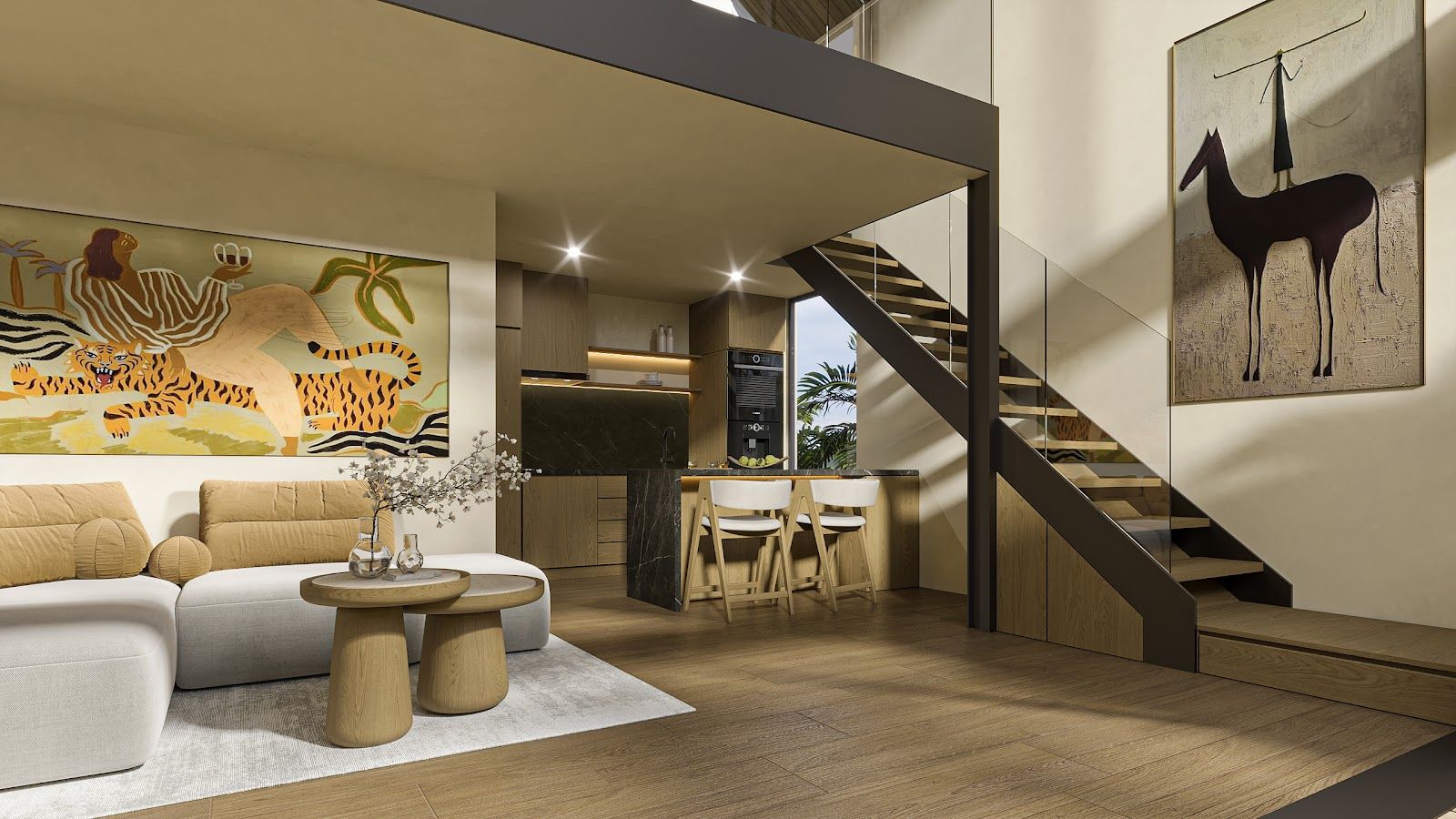
You can live in your Bali home part of the year and rent it out for the rest. A management company lets, cleans and maintains it while you are away, Indonesian tax is withheld on the rent, and in a strong Sanur location the income can cover running costs and contribute meaningfully to the purchase.
Key takeaways
- The use-it-and-rent-it model works best in managed complexes, where handover between owner stays and guest stays is routine.
- Agents advertise 7 to 10 per cent gross full-year yields for well-located Sanur villas; a six-month owner should model roughly half the gross, then deduct to net.
- Passive rental income is compatible with retirement and long-stay visas when the tax side is handled correctly. No work is permitted on a retirement KITAS.
- Non-residents pay 20 per cent final withholding on gross rent, residents 10 per cent, per PwC's Indonesia tax summaries.
- Sanur's demand base is unusually balanced: holiday guests in the dry season, long-stay tenants year round.
Can you rent out your Bali home while you are away?
Yes. Foreign owners routinely let their Bali property during the months they are not using it, through a licensed management operator that handles listings, guests, housekeeping and repairs. The owner's job reduces to reading a monthly statement.
Two conditions make it legitimate. First, the holding structure must support rental use: a well-drafted leasehold or a PT PMA operating structure, arranged at purchase. Second, the tax must be handled, since Indonesian tax applies to rent whether you let for four weeks or fifty. There is also a visa nuance worth knowing: holders of a retirement KITAS are not permitted to work in Indonesia, but passively earning rent on a property you own is not employment when structured and taxed correctly. The details, including where the line sits, are in can you work, volunteer or rent out property on a Bali retirement visa.
How does the occupancy maths work for a six-month owner?
Start from the full-year benchmark and halve it, honestly. Agents advertise 7 to 10 per cent gross annual yields for well-located Sanur villas; treat gross figures with caution and model net. An owner releasing the property for roughly six months captures a share of that, and the share depends heavily on which six months.
Bali's peak demand runs through the dry season, roughly April to October, plus the December holidays. A European owner who winters in Sanur from November to March, the pattern described in our snowbird's guide to wintering in Sanur, hands the property to guests for precisely the months that earn best. An Australian owner splitting the year the other way gives up some peak weeks but gains the Christmas trade. Demand behind those seasons keeps deepening: Bali received 6.9 million foreign arrivals in 2025, up 9.7 per cent on 2024, per BPS Bali, with Australians the largest source market at roughly 1.63 million. A realistic target for a well-run six-month release in Sanur is rental income that covers service charges, management fees, utilities and tax, with a surplus that offsets the cost of ownership. Anyone promising that half a year of letting will fully repay a purchase quickly is selling, not modelling.
Which rental model fits: holiday lets, long stays or a mix?
Match the model to your absence pattern. Predictable long absences suit a fixed-term long stay let; flexible or shorter absences suit holiday letting; many Sanur owners blend both, taking a long-stay tenant for a defined block and holiday guests around it.
| Model | Income profile | Flexibility for the owner | Wear and admin |
|---|---|---|---|
| Holiday lets only | Highest nightly rates, seasonal swings | High: block your own dates freely | Frequent turnovers, more housekeeping |
| One long-stay tenant while away | Lower rate, but contracted and stable | Low: dates fixed by the tenancy | Minimal; one handover per cycle |
| Blended (long block + holiday edges) | Balanced, captures peak weeks | Medium: planned around seasons | Moderate; needs an organised manager |
Sanur rewards the long-stay end of that table more than most of Bali. The town's tenant pool includes retirees trialling the island before buying, families near Bali Island School, and professionals connected to the KEK Sanur health zone, a development representing roughly USD 620 million of projected investment under Government Regulation 41 of 2022. Long-stay tenants book months, not nights, which flattens the seasonality a part-year owner would otherwise feel.
What does a management company actually handle?
Everything between your departure and your return: listing and pricing, guest vetting and check-in, housekeeping and linen, maintenance and pool care, bill payment, tax withholding and owner statements. Good operators also store your personal effects in an owner's lock-up between stays.
The difference between a managed complex and a standalone villa shows up here. A standalone villa needs its own staff, its own security and someone watching for wet-season mould while you are 12,000 kilometres away. In a purpose-built complex the infrastructure already exists: reception, housekeeping, engineering and a rental desk that treats your unit as part of a professional inventory. At Sanuuri Residences in Sanur, short and long term rental management is run in-house by Investland Bali, the developer, and every residence hands over fully furnished, which means rental-ready from day one. Fee structures and reporting standards to demand from any operator are covered in property management in Bali: what to expect, and the broader case for the format in why managed complexes suit part-year residents.
What about tax on the rent?
Indonesian tax applies no matter how few weeks you let. Non-residents pay a 20 per cent final withholding tax on gross rental income, and Indonesian tax residents, 183 or more days in country, pay 10 per cent, per PwC's Indonesia tax summaries. The tax is final, so the calculation is simple and there is no further Indonesian income tax on the same rent.
A competent manager withholds and remits for you, and the receipts matter beyond compliance: they are the paperwork that lets your bank repatriate income smoothly and the evidence a future buyer will want at resale. Home-country obligations continue in parallel, and tax treaties can change the effective position, so take advice on your specific residence pattern, particularly if you split the year evenly, as many owners described in the part-year retirement between Australia and Bali do.
Frequently asked questions
Can I rent out my Bali property while I am back home?
Yes. Owning and passively renting out property is permitted for foreigners with a properly structured holding, and a licensed management company handles guests, cleaning, maintenance and compliance while you are away. Holders of a retirement KITAS cannot work in Indonesia, but passive rental income with the correct tax treatment is not employment.
How much can six months of renting realistically cover?
For a well-located Sanur property, agents advertise 7 to 10 per cent gross annual yields on full-year rental; treat gross figures with caution and model net. An owner who releases the property for roughly half the year, especially across the busy dry season, can reasonably aim for rental income that covers running costs, management and taxes, with a contribution left over. The exact outcome depends on season, pricing and unit type.
What happens to my personal belongings when guests stay?
Managed complexes use an owner's lock-up: a secure wardrobe or storeroom where personal effects are stored between your stays. The unit is then presented as a furnished rental. On your return, housekeeping resets the home with your belongings in place. This is far simpler in a purpose-built complex than in a standalone villa with your own staff.
Is rental income taxed if I only rent part of the year?
Yes. Indonesian tax applies to the rent regardless of how many weeks you let. Non-residents pay a 20 per cent final withholding tax on gross rent and Indonesian tax residents pay 10 per cent, per PwC's Indonesia tax summaries. A good management company withholds and remits this for you and includes it in your statements.
Sources
- BPS Bali (Badan Pusat Statistik), foreign arrivals data, 2025
- PwC Indonesia tax summaries, withholding and individual taxation, 2026
- Government Regulation 41 of 2022 establishing KEK Sanur