
Buy an apartment in Bali if you want a lower entry price, minimal upkeep and lock-up-and-leave convenience; buy a villa if you want land, privacy, a private pool and stronger holiday-let earning power. On net returns the gap is smaller than agents suggest, once management, maintenance and empty weeks are modelled honestly.
Key takeaways
- Apartments win on entry price, running costs and absentee ownership; villas win on space, privacy and peak holiday rates.
- Sanur freehold villas near the beach run roughly USD 300,000 to 800,000, with leasehold entries from about USD 175,000, per July 2026 listings. Apartments open the market below the villa threshold.
- Net yield, not gross, decides the contest. A villa's pool, garden and staff can absorb the nightly-rate premium.
- Foreigners hold either through leasehold, or through Hak Pakai strata title if they hold a KITAS or KITAP. Nominee freehold is illegal.
- Resale hinges on remaining lease term, which is why longer leases such as Sanuuri's 50 years carry real weight.
Should you buy an apartment or a villa in Bali?
Choose by use pattern and tolerance for upkeep, not by category prestige. Owners who visit part-year, live abroad or want predictable costs are better served by apartments in managed complexes. Owners who will live in Bali most of the year, want gardens and total privacy, or plan to operate a serious holiday-let business are better served by villas.
Bali's market has been villa-dominated for decades, so most advice you hear is villa advice by default. That is changing for a structural reason: the island's fastest-growing buyer groups, retirees and part-year residents, are precisely the people standalone villas serve worst. Demand is not the constraint. BPS Bali counted 6.9 million foreign arrivals in 2025, up 9.7 percent on 2024, with roughly 1.63 million Australians, the island's largest source market and one that skews older in Sanur. The real question is which physical format converts that demand into income and liveability with the least friction for you.
How do the purchase economics compare?
Villas cost more in absolute terms because you are buying land as well as building. In Sanur, freehold villas near the beach run roughly USD 300,000 to 800,000, and leasehold villa entries start around USD 175,000 on July 2026 listings. Apartments and lofts open the same neighbourhoods at lower absolute prices, which is what makes them the practical entry into premium locations.
The lower ticket does more than spare your capital. It widens your future buyer pool at resale, and it can leave budget for the thing that actually drives returns, which is location. A well-placed apartment two minutes from the beach will out-earn a remote villa bought for the same money in most years. Transaction costs apply to both formats alike: per PwC's Indonesia tax summaries, the buyer pays a BPHTB transfer tax of 5 percent of assessed value, the seller pays 2.5 percent final income tax, and new-builds from developers attract VAT of around 11 to 12 percent. For a current view of what villa money buys in this town specifically, see how much a villa in Sanur costs in 2026.
Which rents better, an apartment or a villa?
Villas command higher nightly rates in the holiday market; apartments fill more reliably in the long-stay market. Which earns more for you depends on the tenant you are actually serving. In Sanur, where demand is dominated by retirees, medical staff and families staying for months, the long-stay economics favour apartments more than the island-wide averages suggest.
Be sceptical of category-level yield claims. Agents advertise 7 to 10 percent gross yields for well-located Sanur villas; treat gross figures with caution and model net. A villa's gross premium is earned through costs an apartment does not carry: private pool servicing, garden staff, higher utilities, more frequent repainting and repairs in a tropical climate, and steeper cleaning bills on every changeover. Apartments in managed complexes replace most of that with a predictable service charge. The gross-to-net waterfall, and why 15 percent guaranteed offers should send you walking, is covered in Bali rental yields explained.
What about maintenance, security and lock-up-and-leave?
This is the least discussed and most decisive difference. An apartment can be locked and left for six months; a standalone villa cannot. Bali's humidity, rain and salt air punish an empty building, and an unwatched villa needs paid staff for security, pool chemistry and mould control whenever you are away.
For part-year owners the arithmetic is stark. Villa absence costs are permanent staffing and supervision obligations that run every month you are not there. An apartment owner pays a service charge that covers security, common-area upkeep and building maintenance regardless of occupancy, and hands the keys to management on departure. This is the core argument in our case for lock-up-and-leave property in Sanur, and it is the reason managed complexes are the default format for part-year residents in most mature holiday markets.
How do ownership structure and resale differ?
Both formats are held by foreigners through the same legal routes: leasehold (Hak Sewa), which is contractual and open to anyone; or Hak Pakai title for individuals holding a KITAS or KITAP, which is also the route for strata apartments and runs 30 years, extendable to 80 in total. Freehold is not available to foreigners, and nominee arrangements, where an Indonesian holds title on your behalf, are illegal and unenforceable. Do not entertain them for either format.
At resale, the dominant variable is the remaining lease term, not the property type. Typical Sanur leasehold terms run 25 to 30 years with negotiated extension options, which means a buyer ten years in is selling a 15 to 20 year remainder, and pricing reflects it. Longer initial terms hold value better; Sanuuri Residences sells on a 50-year leasehold, materially longer than the Sanur norm, precisely to protect that resale curve. The structural detail sits in leasehold vs freehold in Bali explained.
Apartment or villa: the side-by-side comparison
The table below compresses the trade-offs. Read the last row first: the deciding factor is nearly always how you will actually use the property, not which category theoretically yields more.
| Factor | Apartment / managed unit | Standalone villa |
|---|---|---|
| Entry price | Lower; below villa threshold in the same location | Higher; land plus building, USD 300K to 800K freehold near Sanur beach |
| Running costs | Predictable service charge covers building, security, shared pool | Variable: pool, garden, staff, repairs, higher utilities |
| Rental sweet spot | Long-stay tenants: retirees, professionals, medical staff | Holiday lets and families wanting privacy |
| Absentee ownership | Lock up and leave; management on site | Needs staffing and supervision year-round |
| Privacy and space | Shared amenities, no private land | Private pool, garden, no shared walls |
| Legal route | Leasehold, or Hak Pakai strata with KITAS/KITAP | Leasehold, Hak Pakai, or PT PMA with HGB for rental businesses |
| Best owner profile | Part-year residents, first-time Bali buyers, yield-focused investors | Full-time residents, hands-on operators, larger families |
How does this choice map to Sanuuri's unit mix?
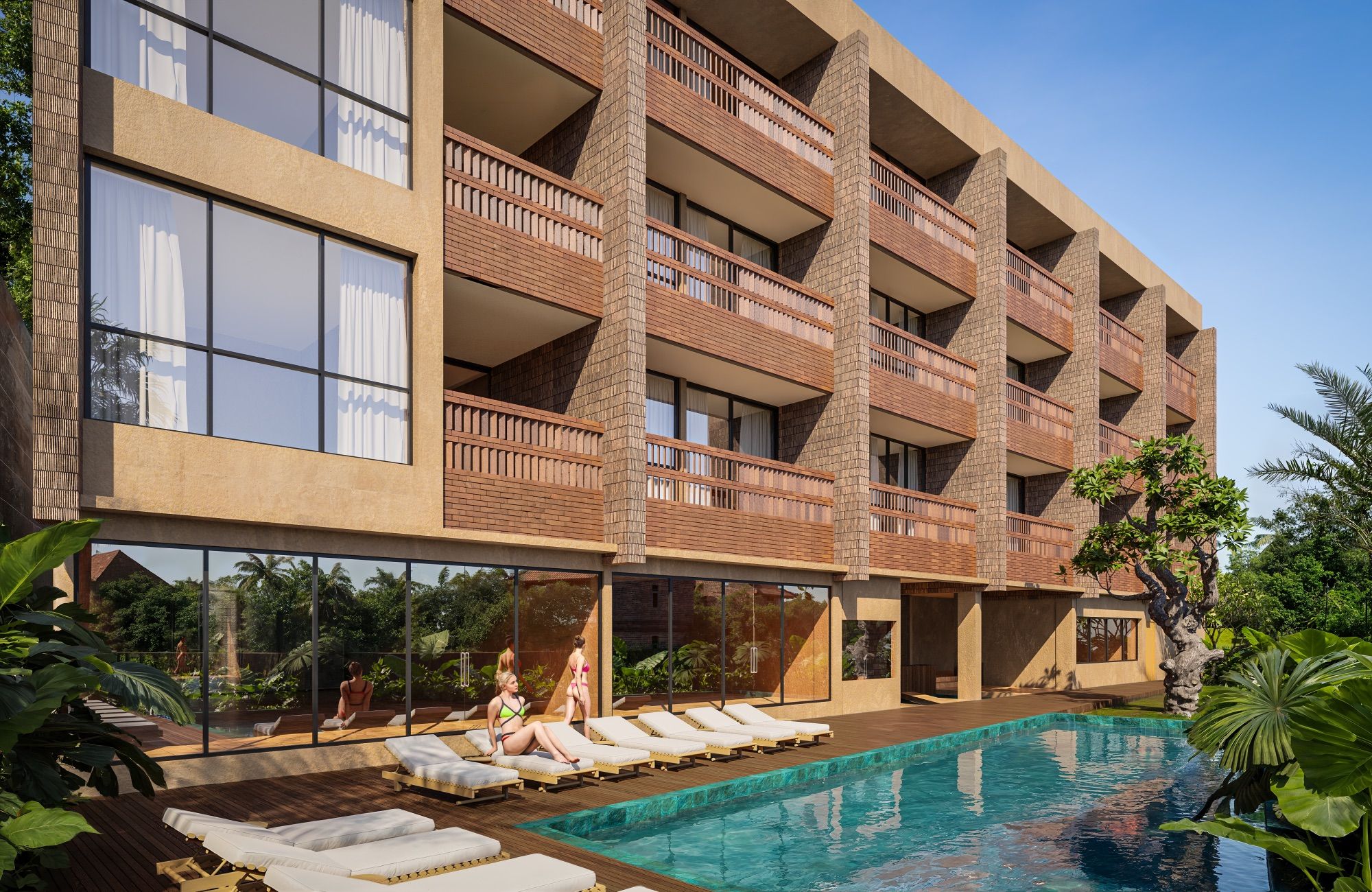
Sanuuri Residences in Sanur was designed so buyers do not have to force the choice. The complex mixes apartment formats with private-pool villas on a single site, all on the same 50-year leasehold, all handed over fully furnished, all managed by Investland Bali for short and long stays.
The range runs from a 2-bedroom apartment of 73.5 square metres with a shared pool, through a 1-bedroom loft with a mezzanine bedroom and private terrace, to 1-bedroom and 2-bedroom private-pool villas and a two-floor 3-bedroom pool villa on 140 square metres of land with 163 square metres built. Every unit shares the complex's plunge pool, gym, sauna, co-working lounge, concierge lobby and restaurant, and the beach is a two-minute walk. In practice, apartment logic and villa logic converge here: villa buyers get managed-complex services, apartment buyers get villa-grade amenities. Unit specifications, floor plans and the buying process are laid out in the Sanuuri Residences buyer's guide, and 3D walkthroughs of each type are at tours.sanuuri.com.
Frequently asked questions
Can foreigners legally own an apartment in Bali?
Yes, through two routes. Leasehold (Hak Sewa) is a contractual right open to any foreigner with no visa requirement. Strata-title apartments can also be held under Hak Pakai by individuals holding a KITAS or KITAP, running 30 years and extendable to 80 in total. Freehold (Hak Milik) is not available to foreigners, and nominee arrangements are illegal.
Do villas earn higher rental yields than apartments in Bali?
Villas usually earn more per night in the holiday market, but they also cost more to buy, staff and maintain. On a net basis, after management, pool and garden care, voids and tax, well-located apartments are often comparable. The honest answer depends on the location and the tenant type, not the property category.
Which is better for an owner who visits Bali a few months a year?
An apartment or a unit in a managed complex. You can lock the door and leave, with security, pool care and maintenance handled by the building rather than by staff you employ personally. A standalone villa left empty needs paid supervision and still deteriorates faster in Bali's tropical climate.
Are Bali apartments easier to resell than villas?
The resale market for villas is larger because villa stock dominates the island. Apartments trade on different strengths: a lower absolute price widens the buyer pool, and units inside a professionally managed complex with documented income are straightforward for a buyer to assess. In both cases, what matters most is the remaining leasehold term.
Sources
- BPS Bali (Statistics Indonesia, Bali Province), foreign arrivals data, 2025 to 2026
- PwC, Indonesia tax summaries, 2026
- Sanur property listings survey, July 2026